

 RSS Feed
 Apple Podcasts
 Spotify
 Amazon Music
 Overcast
 iHeartRadio
 PocketCasts
 Castbox
 Podchaser
 Podcast Addict
 E338 Des Rocs on Writing the Theme to Borderlands 4, Embracing Imperfection, and Making Albums in the Age of TikTok
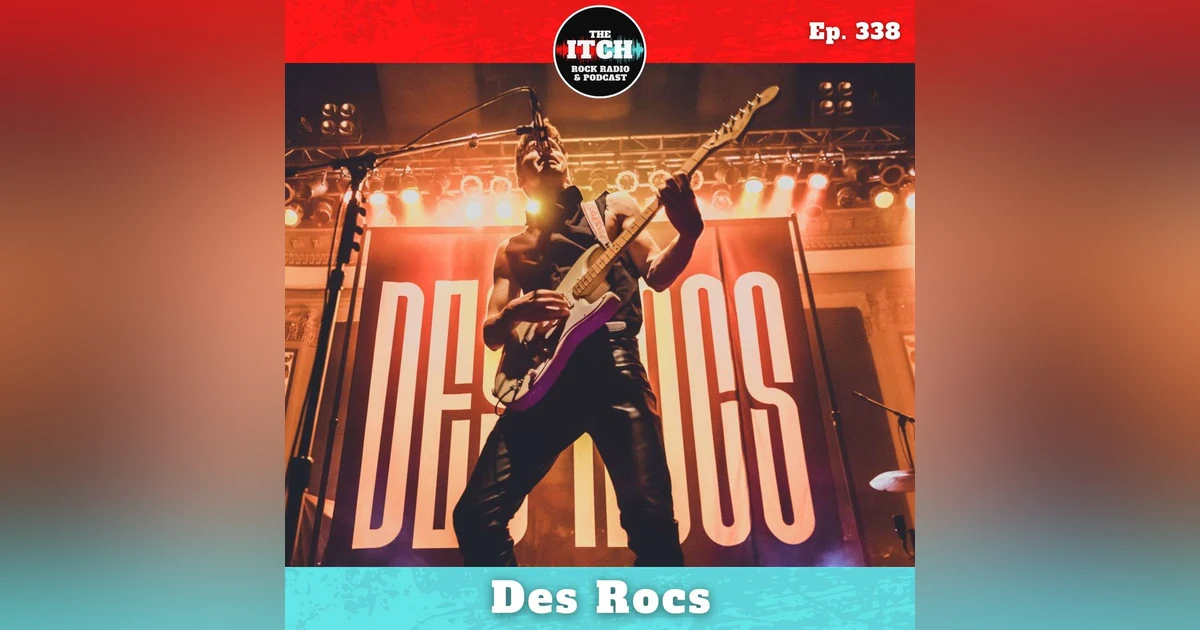
This week, we're scratching The Itch for a triumphant return! Des Rocs first appeared on The Itch over four years ago to discuss his debut album A Real Good Person in a Real Bad Place. Since then, he's toured the world, dropped his excellent second album Dream Machine, and even sailed the seas on Shiprocked. And we've covered his live show on the podcast at least half a dozen times. Now he's back with his third album, To Hell and Back, and we were well overdue for a proper catch-up.
Though we wish we could've had him back sooner, the long gap between conversations gave us the opportunity to dive deep wit Des on how he's changed as a person and a performer over the years on a journey that may not have taken him to hell, but has taken him from dingy recording spaces all the way to placement on massive TV programs and video games.
And as always, Des is a man of rock and roll principles, so we had to dig into his dedication to releasing full albums in the age of TikTok singles, as well as his belief that if you've gotta play the social media game, you might as well poke the bear a bit while you're at it. Enjoy.
Listen to The Itch Rock Radio Show Rock with us every Sunday night from 6-9pm CST on KCLC-FM in St. Louis. Outside the area? Stream online at 891thewood.com, TuneIn, Radio.net, and OnlineRadioBox!
Connect With The Itch For any and all friendship, questions, inquiries, and offers of pizza, The Itch can be found at the following: Website: itchrocks.com Facebook: Facebook.com/itchrocks Instagram: Instagram.com/itchrocks Email: itchrocks@gmail.com
Support the Show Thank you so much for listening. If you like what you hear, please subscribe and leave a positive review and rating on Apple Podcasts, Spotify, or Podchaser to help our audience grow. Reviews only take a minute and help us reach more rock fans just like you.
Credits Our theme song, "Corrupted", is used with permission from the amazing Skindred. All other content is copyright of The Itch. All rights reserved, including the right to rock on.
Des Rocs: This is the one and only Des Rocs. And you're listening to the one and only, The Itch.
KC: You're listening to the Itch. My name is KC.
Dan: My name is Dan.
Aaron: And I'm Aaron. And this week, we are scratching The Itch to go To Hell and Back. We have a returning guest. We're here with the one and only Des Rocs. So it's good to see you.
Des Rocs: Good to see you guys, too.
Aaron: Yeah, I know you're out traveling about a little bit here, and so we appreciate you making some morning time for us.
Des Rocs: Absolutely, my man.
KC: And this is currently our longest gap between returning guests, almost four years ago to the day.
Des Rocs: Really? It's been that long. But I feel like I see you guys all the time in between podcasts. So, yeah, I get to scratch my itch that way, you know?
Dan: We last interviewed you on July 18th of 2022, and we realized that since then, we've now seen you live and talked about you in no fewer than seven different episodes over the last four years.
Des Rocs: Wow.
Dan: It's just kind of become a running bit that KC doesn't miss a chance to see you, Doc, and Tully do your thing.
Des Rocs: I guess I've been in Missouri a lot more than I realize. And Shiprocked, too.
KC: Yeah.
Dan: You're definitely a road warrior, for sure. You're always touring.
Des Rocs: Yeah, we put a lot of miles. A lot of miles. For sure.
Dan: What do you think has changed most about your live show since we first talked?
Des Rocs: Oh, that's a really great question. So this is four years ago. In my live show, I used to be really paranoid about planning everything and controlling everything. And I think as I've gotten more mature as an artist, I've become, like, way more comfortable and, like, whatever could happen might happen. And if things go wrong, you know, because things go wrong all the time. Both, you know, you have a bad night playing, your gear breaks down, just not letting it get to you at all. And just thinking, like, this is part of the journey of what live performance is, so embrace it and double down on it. That's been a big change for me, too. And also, I've pushed so much what I'm capable of physically, and musically, because again, I'm not like, any sort of a savant musician by any means. And physically, like, I'm not, I've never been, like, overly athletic, so I'm always just pushing what I, what I think I'm capable of doing,
Dan: You know, to that point. When we saw you live this last time at Delmar Hall, you. You did actually have some, something go wrong. I think your guitar like just lost power or just stopped playing and they were like trying to fix it and Doc was running around like a madman playing the bass line, holding the show up. And the very next song, you just did like an acoustic song, just you and acoustic guitar. It was, it was incredible, by the way.
Des Rocs: Oh, thank you.
Dan: We had the pleasure of being near somebody that I guess was following you on tour. And so they, they had told us that was like the first time that actually happened. So it was, it was a treat for us to get to see you play that acoustic song. Even though it was not planned.
KC: Yeah.
Des Rocs: Oh, yeah. I guess art imitates life. Because later in the show we were, I was going to do a bit where I pretended the amp broke and I was going to make a whole like, joke out of it's sticky, but I just think it's hilarious. I love stuff like that. But then the amp actually did break in the beginning of the show. So it was, and it was like right in the beginning, right when you're just getting started. But yeah, the first moment you're like, ah, what's wrong? I hope my gear is okay. You put so much time and attention and love and money into this kind of stuff. And you're like, it's not really busted. And then you're like, okay, they're figuring out. It's fine. It's not like I'm playing live on TV right now, it's like this is what live performance is all about, you know?
KC: Yeah. And at that Delmar Hall show in St. Louis, we saw you afterwards and you let us know ahead of time that you were going to be on Shiprocked. And we're super excited to see you on the boat again.
Des Rocs: Oh yeah, I'm looking forward to it. I think it's a different boat this time though, right?
KC: Yep, it is.
Aaron: Yeah.
Des Rocs: Is it a nicer boat? A less nice boat? What do you think?
KC: It's got pros and cons. It's a nicer boat, but as far as the venues themselves, it's hit and miss. As far as better or worse,
Des Rocs: Really? Wow.
Dan: Inside venues are smaller is what I feel. like, the theater is smaller. The Limelight Lounge is smaller. So that's my only thing is, like, I was hoping for more area, but the ship itself is super nice, so definitely can't complain there.
Des Rocs: Wow. Nicer boat, smaller theater. That's fine. I'll take it.
Dan: Yeah. And there's no seats in the theater, so that's my favorite part, too, because that was just weird, being right up in front and having to sit down or have seats in the.
Des Rocs: Yeah, seated theaters are my nightmare, dude. I hate seated theaters. Unless I'm doing something acoustic. I always say, I dare you to sit down to this. That's what I say when I do a city theater. Yeah.
KC: Right.
Dan: Nice. Awesome.
KC: As a quick personal thing, I just really appreciate the personal shout-outs that you've given me from the stage on more than one occasion.
Des Rocs: Oh, of course, KC!
KC: It's very affirming to make a positive impression on that one conversation.
Des Rocs: Of course. Man, you're so tall. You're easy to find in the crowd. It's easy. It's tough when there's somebody I know in the crowd who's, like, five foot one, it's very tough to give them a shout out.
KC: Yep. Thank you.
Des Rocs: Of course.
Dan: Let's talk about the new album. You just released your third album, To Hell and Back. We unfortunately missed talking to you around the release of your second album, Dream Machine. So in a way, this is us catching up on two chapters at once. So how do you feel you've grown into your sound since you've released A Real Good Person back in 2021?
Des Rocs: Oh, wow. A, tremendous amount. You know, all these albums reflect where I am at a very specific time and place. So. A Real Good Person. It's my first album. I'm, navigating COVID as an artist. I'm sitting alone in an abandoned radio station in Greenpoint, Brooklyn. That is unimaginably disgusting. And I'm just sitting there and creating an album with literally nothing, like a guitar, a couple pedals, and a laptop, and that's it. And trying to bring to life, like, almost this weird, introspective rock opera inner monologue. And that's, like, at hat time, what that album was, it was a huge departure from anything I had done, but also indicative of, like, who I am as an artist, which is. I don't care Like I'm just going to do whatever inspires me. And hopefully at the end of the day, it all feels like Des Rocs. And then after that, coming out of COVID I really wanted to like, embrace the live band more because I literally could in a way I couldn't during the Real Good Person era. And that was Dream Machine. And it was very much the opposite of A Real Good Person, where it was very extroverted and really, just like an optimistic and fun and empowering album. And then coming into this latest chapter of To Hell and Back, I wanted to again, challenge myself and create something that was different than what came before it, but also not just like a departure for the sake of having a departure. I hate when artists take left turns just for the sake of it. It's all an evolution. It's all changing and morphing and there's traces of what came before and there also isn't. And To Hell and Back, I wanted to do it live because I wanted to embrace that just intangible energy of things not being perfect. and yeah, it was, it was a really interesting and very unique recording process for us.
Dan: So when you recorded it live, was that an artistic choice or a financial one?
Des Rocs: Artistic for sure. It just, it does take longer if I'm playing all the instruments myself. But, I wanted like that rub, I wanted that push and pull and I wanted to just kind of be a little bit more purist about things than I usually am. There's tons of like DIY laptop computer generated noises on this record. but I wanted the foundation of it to be like a live rock band and the way and to sound and feel like my favorite records of all time feel. Whether it's like Queen or AC/DC or Led Zeppelin, like the vast majority of those records, it's the guys in the room playing together and all the mics have bleed. You can hear some of the bass and the drum mics and vice versa. And that is just like this tried and true recipe that a lot of bands abandoned a long time ago. But there's something human in that and there's a reason why that music is still the most listened to music of all time.
KC: Yeah. How much did you think about the album as a whole journey versus a track by track situation?
Des Rocs: Oh, I'm always very, very big picture. Like I don't deal in songs and then finish a bunch of songs, then shuffle the deck. There are themes I like to connect. There are sonic themes that I really like to connect and almost like motifs, you know, like a comedian does a callback at the end of a set. It's like they start with one killer joke and at the end and like. And that's why blank and it calls back to something else. The whole kind of rubs lights out.
KC: Yeah.
Des Rocs: Like, these are just like amazing choices and performances that I like to draw from, So I do the same thing with, with Sonics and I just bury the whole thing with lots of little Easter eggs that are kind of mainly for myself. But sometimes fans pick up on them, which are very cool. And, yeah, man. It's not. It's not a track by track thing. I'm not a singles artist. I've never had a hit song. You know what I mean? That has, like, defined my career. I have the benefit of having lots of songs. Each one I love and stand by and can be just as popular as what a single technically is.
Aaron: That's something we really appreciate about you and your approach. As you just mentioned, you're kind of raised on and appreciating kind of the old school, the timeless stuff. And even now in this day of people making songs for TikTok and whatnot, you're like, I'm gonna make full albums. And so not that we have to wait very long between albums for you, but it does make them worth waiting for because we know that they are given that level of like, intricate care and thought about how it all works together as a big piece of work.
Des Rocs: Oh, definitely. It's so stupid how much thought I put into the albums and how much attention I give to like 11 or 12 songs over the course of 18 months of my life. It is all consuming, it is disturbing, it is dystopian. And to be doing all of that in a culture that really doesn't appreciate long form content, you, know, it's just. It's who I am, you know? I can't change that. Like, I love film, I love movies, I love albums. I love listening to an album. It gives me so much pleasure to go on the whole journey from the top. I love singles too, but I'm not like a single artist. I don't write like, I need a single. I need a single. I don't think like that. I only think like, oh, and this would be an amazing fourth song an album, and I'll take you here and then we'll go there. That's just kind of like how my brain works very much to the detriment of my career. Any sort of, like, financial incentives I'm supposed to be having here? I think people would be a lot happier with me if I did think in terms of singles and hits, but it's just. It's not who I am.
Aaron: There are bands out there that make their career doing that where it's like they never have necessarily the big. The defining song that you think of when you think about them, but they will carve out a space in the music world and a very respectable career, financially sustainable career. I'm curious, do you. I feel like there might be kind of a freedom with that, like, oh, I don't have to play X song to close my set because it's the thing that people want. So I'm curious if. Would you be perfectly satisfied if that was kind of how your career plays out? You never necessarily have the one big one, but you're continually slowly climbing that mountain?
Des Rocs: Totally. Like, I don't give a fuck, you know? I don't care. I don't care what I play. There's no song of mine that was on a CW show that I have to close it out with and all. But also, even if there was, that would be totally fine because there's no song I will put out that I'm not in love with or stand behind or meant something to me at a specific time. Like, I have songs that have streamed more popularly. I love those songs so much. I'm never playing Use the Darkness and Let Me Live. And I'm never rolling my eyes being like, not this one again. I'm like. I'm like, oh, man, this is incredible. I'm like, a fan of it. I'm like, oh, I'm so happy I get to play this. So happy I have this is so cool. I love this. I was like, I could never write a song like that today, you know, because that's 2018 Danny, you know? So I can never do that, and that's cool. I'm like, wow, I couldn't even. This is like somebody else's song almost.
KC: That was something that stood out when we saw you the last time is you kind of had, like, a little medley of snippets of songs, and it kind of gave everybody, a chance to hear some of their favorites that you might not otherwise in your current set. So good job.
Des Rocs: Oh, thank you. Yeah. I was like, I don't play a lot of Real Good Person because I'm out here showing everyone all my new songs. So striking that balance and walking those lines. It's very, very tough. And I've seen so I've learned from so many artists I've seen do it so poorly. Like they've got a bunch of music and they go out and they play like 90% of the new stuff and then a couple of tried and truth at the very end and there is like an art. And this is why I love going back to long form performance. Like I love headlining. I hate opening. I love headlining because I got 95 minutes to take you on this journey. And in that journey I feel like I can again, not to use this pun, but scratch every itch of paying homage to all the chapters but not being beholden to any of them.
KC: Yeah.
Des Rocs: So I get to play you like four, like half the new album. But I'm also going to give you like half of my first album but I can't physically play all of that around enough time. So I'm going to give you a medley where each song is like two plus minutes. I'm not going to just do a medley. I'm also going to put in this like crazy like Latin inspired jam in between it and then take it really fast and take it all the way down to nothing, like that push, pull. And also here's the thing. I don't want to just check all the boxes just for the sake of checking all the boxes. This is just like what I feel like I needed to do. I felt like I needed to pay homage to all these different chapters because I know there's an equal amount of fans of each one and I want to make sure everybody goes home and like, wow, I got a full experience. I got the full spectrum of sounds that he likes to play in, you know?
KC: Yeah.
Aaron: I'm curious as we maybe diving a little bit into the songs in particular here, obviously we just talked a whole bunch here about your live show. We've got some phenomenal guitar work and presence and all that on stage. kind of getting into like the granular stuff of the album itself. I'm curious, is there a lyric somewhere on this new record that means something particularly special to you?
Des Rocs: Oh, wow. Well, I mean they, they all do. It's like, it's, it's very tough to think of one I guess unless I had like all the lyrics sitting out in front of me and I could kind of go through them all and read them. I, mean, they all do. There's only a very few songs in the DES Rocs universe that I write just from, like, a purely fun and free and fantastical kind of perspective. And that's just kind of like playing dress up and having a lot of fun. But the rest of the work and why it takes me so long to make the albums is because it's deeply real and deeply personal. So I'm pulling a lot out of myself. And it's emotionally, can be very exhausting.
Aaron: I mean, on that note, was there any song in the recording of To Hell and Back that you maybe loved, but it just didn't feel like it was hitting right for a while? Like, maybe you almost even gave up on it before something finally clicked and you were like, all right, now this is where it needs to be.
Des Rocs: Yeah, there was a couple. War was one of them. And we, We must have had, like, 15 different versions of War with complete different instrumentation. some different lyrics, some different melodies and stuff like that one got workshopped to death. Like, I mean, true death. And there, was a couple others that I workshopped to death that didn't end up making the record. I think there were two workshops. but, yeah, sometimes you have to, like, push really, really, really hard on certain songs. And some songs, it's just like, version one is the one. That's it.
Dan: Yeah, and that's kind of what I was wanting to ask is you seem like someone who's always chasing a better version of your own work. Did you ever reach a point where you're dissatisfied with something or just finishing an album mean you've identified the next mountain to climb?
Des Rocs: If I finish the album and it's out, then I'm. I stand by it 100%. I wouldn't put it out if I wasn't like, just 100%, like, oh, this is what I wanted to do, you know? Like, I've. Again, fortunately, I've never had, like. Because I haven't had, like, hits and things like that. I don't have any pressure. I don't have anybody being like, you got to deliver this album, because of this, this, and this. I just take my time. I work fast on my own because I put a lot of pressure on myself. So I always want to, like, keep moving forward and keep exploring things. I'll explore a lot of territory before I land on the album I want to make. I make a lot of music. I mean, I'm talking, like, three or four albums worth of music before I get to the album I want to make. so the pressure is really internal. And that allows me to be very free creatively and to stand by the end result 100% as being like, every single note has been personally inspected by Des Rocs. Like the stamp on it, made in the USA. Every single piece of this production, lyric songs, everything interesting, personally inspected by Des Rocs and approved.
KC: Yeah.
Dan: I wanted to ask about one particular song, Fall Together, because this song has a very Zeppelin esque, almost cashmere feel to it. So was that intentional or did that just come out that way?
Des Rocs: I love Led Zeppelin. I listen to it and there's elements of that I'm always like, oh, it would be cool to have that group. But I didn't consciously do that before the songwriting process. But it's so funny because it's just. If you really listen to them back to back, they're not that similar. They just are halftime with strings.
KC: Yeah.
Des Rocs: And it's people like, once. Bdd. Boom, bdd. And it's just a kind of like rolling thing. And mine's, it's a different rhythm, it's different music, it's different everything. But it's very reminiscent of. Because it's halftime and strings and rocking and rolling. And it just like. It's also, I think, just shows you, like, how little people play in those colors today that. To even have a little bit of that color, people are like, oh, whoa. People don't really do that's. That's Led Zeppelin Kashmir from 43 years ago. You know what I mean? And yeah, it's just. It's just very interesting to me that I think so few bands are exploring that kind of sonic territory in a way that I really want bands to explore. Like the idea of having space in their record and not just having a complete wall of digital sound for the whole time. That's sonically so fatiguing. And I think, like, to bring space back and breathing room in big rock records is very Zeppelin. Yes.
KC: Yeah. Well, one thing that we've talked about as a show over the years is how hard that artist has to fight to just get their name out there. And we want to commend you for the list of things that you've done lately to just expand and get listenership in many ways, because you have your connection with Dana White and UFC, you have this land from Borderlands and, Kelly Clarkson show. So just want to commend you for all the hard work that you're putting in to make a difference.
Des Rocs: Oh, thank you. Yeah, it is a grind. And I don't view that album coming out as the crossing the finish line. I kind of view it as the starting shot, so I'm like, now I'm just like a door to door music vacuum salesman going around trying to like, spread the word of what I've done here and I will scream it from the rooftops until I die. Because again, I just stand so much by the work. I think it's better than any other rock artist today. Like any of my contemporaries, I don't think anybody is doing what I'm doing. I'm kind of in my own little universe here. But it's harder to get started that way because I don't fit into like any niche or scene or sub genre which is. Makes it, it's like a pipeline for bands to be exposed to specific people.
Aaron: Yeah.
Des Rocs: But me, like, I want to make rock music for everybody the way rock bands used to be and make rock music that's artistic but also deeply anthemic and can resonate with people all over the world. So, yeah, I'm just out there fighting the good fight, man, because I so believe in this vision. And there's been so many ups and downs already. Like, I can't go lower than I've been in the past, so I'm just gonna keep going.
Dan: Speaking of another track on the album, you mentioned elsewhere that This Land was in progress when the opportunity to write the theme for Borderlands 4 came about. So beyond having the word land in it, how do you know that this was the right song for that world?
Des Rocs: Oh, it was just a slam dunk, like, they were saying what they wanted. They were like, we want something very otherworldly and, like a little western feeling. And it's gonna take place on this foreign planet where there's gonna be all this shooting up and stuff, and it's gonna be aggressive and kind of like a little disturbing. I was like, please hold my beer. Like, this is what I do. You know what I mean? Like, speak no more. I got you. Yeah, it was just so easy. It was so much fun.
Aaron: As KC mentioned, we talk to a lot of artists about touring and streaming and how just kind of how generally difficult it is to push through and make a living and whatnot in the arts in that way. We haven't really talked with people about the Idea of like, sync licensing. Is that something that you would say you plan to kind of continue to put a focus of sorts on going forward? It seems like a very interesting, not unexplored, but high potential avenue for getting your music out there.
Des Rocs: Yeah, that stuff you just don't control, though. You know, people come to you and they want to use this song or that song. Unfortunately, there's nothing I could do. it's out of my hands. And I tried in the past, like, very aggressively. I had a song called I Am the Lighting and I was like, this should be the fucking song. For the Ford F150 Lightning electric truck. And I made my own commercial. I took footage of it and I hired a voiceover actor and he did an amazing commercial for the Ford Lightning. And I wrote a script and I was like, I'm going to present this to Ford. And I did. I spent weeks working on this thing and I was like, this needs to be that song. And I was like, and it'd be a great way to get my music out there. And, then they discontinued the car. So.
KC: No!
Des Rocs: That happens. Yeah. I failed 99.9% of the time in every cockamamie idea I have.
Aaron: A bit of a left turn here, but this is something I found very entertaining. So I wanted to bring it up just for a sec before we start wrapping up social media posts. The, you put out some things. The Elvis's grandson makes his debut.
Des Rocs: That's right.
Aaron: With the way that the Internet works, were you slammed with DMs about people either asking where you have been Elvis's grandson, or accusing you of just being a full on, I don't know, fraud and liar for that. I know people take these things at such face value when you're just kind of making a joke and trying to draw up a little bit of an audience.
Des Rocs: Yeah, I got a tremendous amount of DMs and posts. I think, what I'm. I guess like, the artistic intent behind those posts is that I am, really sick of our genre drawing exclusively new bands from the children of preexisting rock stars. I don't think their music is necessarily bad. I think if you're good, you're good. I don't care who your parents are. If it's dope, it's dope. That's great.
Aaron: Yeah.
Des Rocs: But I don't think we need to exclusively draw the next crop from there because there's so many amazing artists out there who need a show. And for me to be the grandson of a fucking milkman from Queens, I could not relate less to those people. And I just think it's funny to say that and be so clearly not that because it's one Google search away and for people to go nuts. And I think it's, it's almost like a little bit of a joker. Like, I, just think it's so much fun to rile the pot. And if it puts eyeballs on a little, 20 seconds of my show, then, hey, why not? It's funny. I think it's hilarious. I think I'm overdue for my next one. I like to put them out every couple weeks just to stir the pot.
Dan: Yeah, I don't know if I could pull that off. Like the famous grandson of some radio DJ. Like, I don't think that would work.
Aaron: Doesn't work on our end.
Des Rocs: Yeah, I don't think people will be as. I don't think people treasure radio DJs as much where they'll get as offended as some of the people that I've been referencing. But if you want to say like a grandson of Dick Clark starts podcast, go for it.
Dan: Howard Stern's stepson.
KC: Yeah, yeah, yeah, there you go.
Des Rocs: I just think it's hilarious. And also it's really shining a mirror to the culture and the platforms that we have to engage in. Just, that's something so stupid and so patently ridiculous is what gets eyeballs and that, we're all kind of engaged in this shit shock arms race.
Dan: Yeah.
Des Rocs: Where the only content music that wins is the most shocking or the most unexpected or the one that produces the most cognitive dissonance. And a lot of my favorite artists would not excel in those environments, unfortunately.
Dan: Well, as we wind down, I have a more serious thinker question for you. As we noted earlier, it's been a few years since we've done an interview. We only get these snapshots of where you are as an artist. You said elsewhere that being a musician doesn't really have an endpoint. It's all about the journey. So how would you describe the current moment in your journey, especially compared to where you were around our first conversation?
Des Rocs: Well, I think I'm like a little bit more fatalistic about things, you know what I mean? Like this business is so hard from a business perspective to like sustain oneself as a touring rock artist. Like the margins are zero. So, I'll go out there for months and not make any money and like to think about and, to just be like, it is what it is. Like, I'm just gonna make the best art I can possibly make. I'm gonna tour the fuck out of it. I'm gonna promote the fuck out of it. I'm gonna do everything I can. I'm gonna leave no stone unturned, and whatever happens, happens, because I can't control the end result, you know? So either I get to keep making this music because I think I am capable of. Of making some of the best rap music of this millennia and from, our generation. I think I can do it. I think I got the goods. I think I got the goods to deliver it live and put on a type of show that nobody else is doing. But if the world is not into it and the world is not ready for it, or I was born in the wrong time, either too early or too late. It is what it is, and that's that. And I'm at peace with that.
Dan: Awesome.
KC: One of our favorite things about doing this show is watching artists evolve over time. And it's been our pleasure to watch you be so intentional about building your career. One album, one show, and one opportunity at a time. If the journey is really the destination, it looks like you're on a pretty good road, and we'll always be enjoying the ride along with you.
Des Rocs: Thank you so much, brother. I appreciate the love and support. I appreciate you growing old with me.
Dan: Yeah, absolutely.
Aaron: Well, Des, thank you so much.
Des Rocs: Of course.
Dan: We'll continue to be visible from the crowd every time you come through.
Des Rocs: So I guess I'll see you in the boat in January, huh?
Dan: Yeah. Super stoked for that.
Des Rocs: Killer.
Dan: So thank you very much for listening to the itch podcast. My name is Dan.
KC: I'm KC.
Aaron: I'm Aaron.
Des Rocs: I'm Des Rocs. Sorry, I forgot who I was for a second. Existential moment of dread.
Dan: No problem. And until next time, legends never die.
Aaron: If you enjoyed what you heard in this episode, please subscribe and tell a friend about The Itch.
KC: Check out the show notes for links about the episode as well as our new music playlist. And, where you can hear us every Sunday night.
Dan: And you can interact with us@itRocs.com or on Twitter, Facebook, Instagram, and gmail, all at itchrocks, I T C H R O C K S.


